Sleep science
Do Screens Before Bed Really Hurt Your Sleep?
Screens before bed can affect your sleep, though usually less than headlines suggest. In a small lab study, hours of reading on a bright tablet delayed melatonin and added about 10 minutes to the time it took to fall asleep. What is on the screen, and how late it keeps you up, often matters as much as the light.
Key takeaways
- In a small lab study, hours on a bright tablet delayed melatonin and added about 10 minutes to falling asleep.
- What you watch or read, and how late it keeps you up, often matters as much as the light.
- Dim the screen and the room, keep devices at a distance and stop scrolling in bed.
- Warm display settings help a little; they do not fix stimulating content or a late bedtime.
- Bright morning daylight is the counterweight that keeps your body clock on time.
What did the best-known study actually find?
Most articles about screens and sleep trace back to one lab study. Participants read on a light-emitting eReader for four hours before bed, and the researchers compared those evenings with evenings spent reading a printed book. After the screen evenings, melatonin, the hormone that rises as your body prepares for sleep, was delayed. Participants took about 10 minutes longer to fall asleep and were less alert the next morning.1
That is a measurable effect, and it fits what is known about light and the body clock. Light in the evening tells your internal clock that it is still daytime, and the brighter the light reaching your eyes, the stronger that signal.
Why the result is smaller than it sounds
The conditions in that study were demanding by design: bright screens, four hours of reading, and a small number of people. Your evening is probably different. You may use a dimmer screen for a shorter time, in a room already lit by lamps that also reach your eyes.
Ten extra minutes to fall asleep is also modest. The more meaningful findings may be the delayed melatonin and the groggier mornings, because a body clock nudged later night after night can make a fixed wake-up time harder. Still, one small study cannot tell you how much your own half hour of scrolling matters. That depends on brightness, distance, what you are doing and how sensitive you are.
Light, content or lost sleep: what matters most?
“Screens” bundle together three different things. It helps to separate them, because each has a different fix.
| Factor | Why it can affect sleep | What helps |
|---|---|---|
| Light | Bright evening light signals daytime to your body clock and can delay melatonin | Lower brightness, warmer colors, more distance, dim room lights |
| Content | Work email, arguments, news, games and cliffhangers keep your mind alert | Calm, predictable content near bedtime; leave the inbox for the morning |
| Lost time | Scrolling or “one more episode” pushes bedtime later while your alarm stays put | A stopping time decided in advance; devices out of reach in bed |
For many people, the third factor may be the biggest. Adults should sleep 7 or more hours a night on a regular basis.2 A screen habit that quietly eats into that every night, while the wake-up time never moves, is an easy route into sleep debt.
Do Night Shift and blue light filters help?
The body clock is thought to be most sensitive to the blue part of the spectrum, which is why phones and computers offer warmer evening color settings, such as Night Shift on iPhone. Shifting the display toward amber reduces some of that light, and it is a sensible default. It is only a partial fix, though. Brightness and distance still matter, and a warm-tinted feed is just as hard to put down as a cool one.
Blue-light-blocking glasses follow the same logic. The evidence that they improve sleep is limited and mixed, so treat them as optional rather than essential.
Practical rules for screens at night
You do not have to give up your phone in the evening. A few habits remove most of the downside:
- Dim everything. Turn screen brightness down and swap overhead lights for a lamp as bedtime approaches. The whole room counts, not just the device.
- Go warm automatically. Schedule a warmer display setting for the evening so it happens without you thinking about it.
- Add distance. A TV across the room sends less light into your eyes than a phone held close to your face.
- Choose calm content. Save work email, heated threads and competitive games for the daytime. Familiar shows, gentle reading or audio are easier to put down.
- Decide when you will stop. Pick a stopping time before you start and set a reminder, rather than relying on willpower at midnight. Turning off autoplay helps.
- Charge the phone away from the bed. If it is out of reach, the last scroll and the 3 a.m. check both become harder.
What if you reach for your phone in the middle of the night?
A middle-of-the-night check is where a screen does the most harm for the least reward. The display is bright in a dark room, notifications are waiting, and seeing that it is 3:40 a.m. can start the anxious arithmetic of how much sleep you have left.
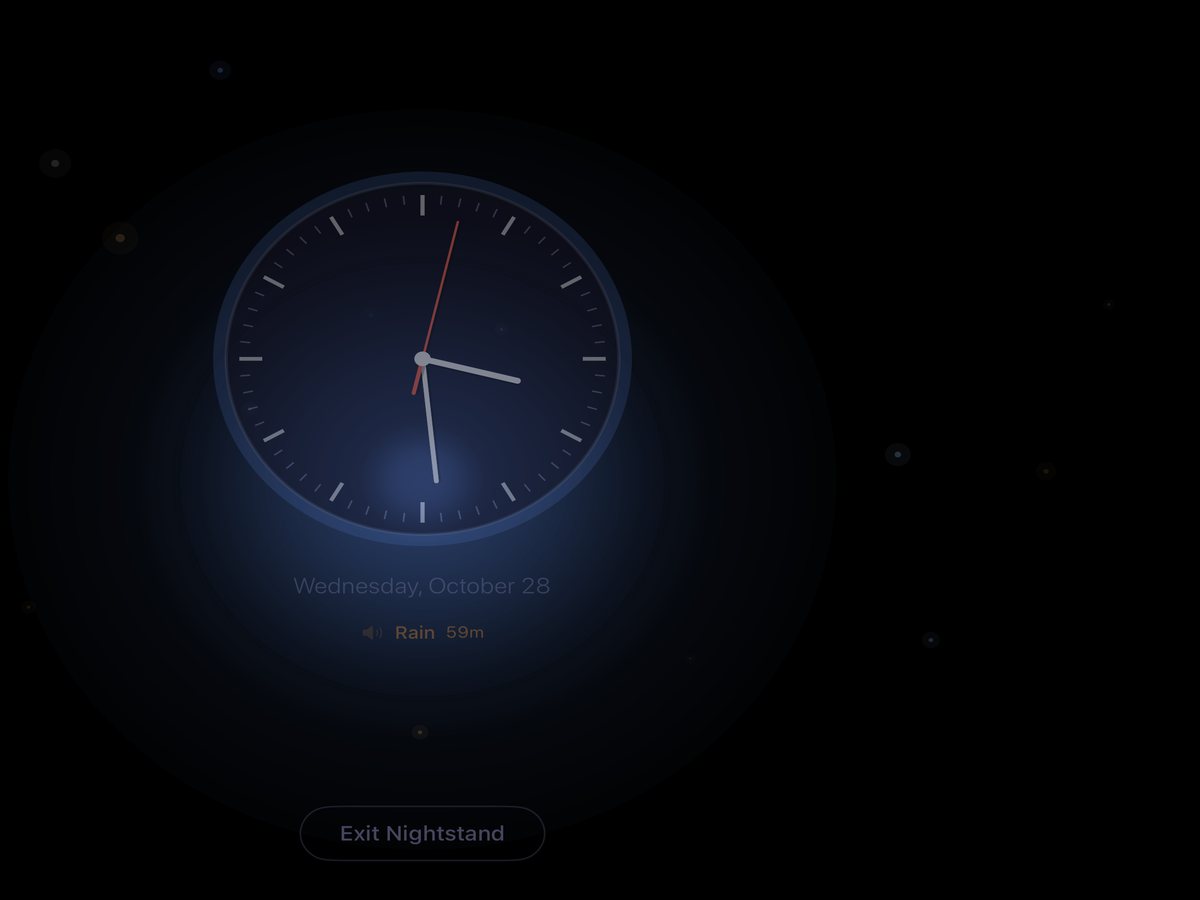
If you want to know the time, a dim bedside clock does that job without the rest; here is how to use your iPhone as a bedside clock. If you have been lying awake for a long time, getting up to do something quiet in dim light and returning to bed when you feel sleepy usually works better than scrolling in the dark.
Why morning light matters as much as evening screens
Evening light is only half the story. Your body clock is set by the contrast between bright days and dark nights, and morning light is one of the strongest signals it gets. In one study, a week of camping with only natural light shifted participants’ body clocks about two hours earlier.3
So one of the most useful habits is not a screen rule at all. Get outside soon after waking, even on a cloudy day, and keep your wake-up time steady. A body clock anchored by bright mornings may be harder to nudge later with an evening on the sofa with a tablet. There is more on this in why a consistent wake-up time matters.
Where to start tonight
- Turn down screen brightness and switch to lamps as bedtime approaches.
- Schedule a warm display setting and turn off autoplay.
- Choose a stopping time and put the phone on charge away from the bed.
- Tomorrow, get daylight early in the morning.
If you still struggle to fall asleep after cutting back, look at the other usual suspects, such as caffeine late in the day or an irregular schedule. Trouble sleeping on most nights for weeks is worth discussing with a doctor; screens are rarely the whole story.
Frequently asked questions
Is it bad to look at your phone right before bed?
A few minutes on a dimmed phone is unlikely to ruin your night. The bigger risks are long sessions at full brightness, content that wakes you up, such as work email, arguments or games, and scrolling that pushes bedtime later. If you use your phone in bed, dim it, hold it further from your face and decide in advance when you will stop.
Do blue light glasses help you sleep?
The evidence is limited and mixed, so they are not a reliable fix. They cut part of the light reaching your eyes but do nothing about stimulating content or a late bedtime. Dimming screens and room lights, and stopping earlier, address more of the problem. If you like wearing them, there is little harm in it, as long as they do not become a reason to keep scrolling.
How long before bed should you stop using screens?
There is no proven cutoff. A practical habit is to put screens away when you start getting ready for bed, leaving a dim, calm stretch before lights out, and to stop sooner if you notice you sleep worse after late screen time. If you fall asleep easily and wake refreshed, your current routine may already be fine.
Is watching TV in bed worse than reading a book?
A TV across the room usually sends less light into your eyes than a phone or tablet held close to your face, so light is less of a concern. Content and time matter more: an exciting series with autoplay can keep you up long past your bedtime. A printed book under a dim lamp remains the calmest option for most people.
Sources
- Chang AM, Aeschbach D, Duffy JF, Czeisler CA. Evening use of light-emitting eReaders negatively affects sleep, circadian timing, and next-morning alertness. PNAS, 2015. doi.org/10.1073/pnas.1418490112
- Watson NF, et al. Recommended amount of sleep for a healthy adult: a joint consensus statement of the American Academy of Sleep Medicine and Sleep Research Society. Sleep, 2015. doi.org/10.5665/sleep.4716
- Wright KP, et al. Entrainment of the human circadian clock to the natural light-dark cycle. Current Biology, 2013. doi.org/10.1016/j.cub.2013.06.039
This article is for general information only and is not medical advice. WakeUp 2day is not a medical device and does not diagnose, treat or prevent any condition. If you are worried about your sleep or your health, talk to a doctor.