Sleep science
How Much Sleep Do You Really Need? Hours of Sleep by Age
Most adults need between seven and nine hours of sleep a night, and at least seven on a regular basis. Teenagers and children need more, and older adults slightly less. Where you fall within the range is personal, and you can work it out with a simple two-week experiment.
Key takeaways
- Most adults need 7 to 9 hours of sleep, and at least 7 on a regular basis.
- Teenagers need 8 to 10 hours, school-age children 9 to 11, and adults over 65 need 7 to 8.
- People short on sleep often do not feel as impaired as they are, so judge by behavior, not feeling.
- Sleep quality and regular timing matter alongside total hours.
- A two-week test with a fixed wake-up time can show your personal sleep need.
How many hours of sleep do you need by age?
A commonly used reference is the National Sleep Foundation’s sleep duration recommendations, which give a range for each age group.1
| Age group | Recommended sleep per night |
|---|---|
| School-age children | 9–11 hours |
| Teenagers | 8–10 hours |
| Young adults and adults | 7–9 hours |
| Older adults (65 and over) | 7–8 hours |
Babies, toddlers and preschoolers need more sleep than any of these groups, daytime naps included. A pediatrician can advise on the youngest children.
For adults, a joint consensus statement from the American Academy of Sleep Medicine and the Sleep Research Society sets the floor: adults should sleep seven or more hours per night on a regular basis.2 The words “on a regular basis” matter. A week of short nights followed by one long sleep is not the same thing.
Why is the recommendation a range and not one number?
Because people differ. Sleep need is partly inherited, and it shifts with age, health, pregnancy, illness and how demanding your days are. Two healthy adults of the same age can need noticeably different amounts and both be normal.
What appears to be uncommon is doing well on much less than the recommended range. Many people who believe they have adapted to short sleep have adapted to feeling tired instead. In one lab study, people limited to six hours in bed for two weeks developed attention deficits comparable to up to two nights of total sleep deprivation, yet largely did not feel that impaired.3 That gap between how you feel and how you function is at the heart of how sleep debt builds up.
What are the signs you are not getting enough sleep?
Since your own sense of tiredness is unreliable, look at what you do instead of how you feel. These patterns suggest your nights are too short:
- You need an alarm every day and would sleep well past it if you could.
- You sleep much longer on days off than on work days.
- You fall asleep almost the moment you lie down, or doze off in meetings, on the couch or as a passenger.
- You rely on caffeine to feel normal, not just as a pleasant habit.
- Your concentration, patience or mood dip in a way that lifts after a few longer nights.
Drowsiness behind the wheel is the sign to take most seriously. If you are fighting to stay awake while driving, pull over and rest. It is a safety problem, not a willpower problem.
Do quality and timing matter as much as hours?
Hours are the easiest thing to count, but they are not the whole picture. A long night that is repeatedly interrupted by noise, heat, alcohol, a snoring partner or a breathing problem does not restore you the way continuous sleep does.
Timing counts too. In a study of about 61,000 UK Biobank participants, more regular sleep and wake times were associated with lower mortality risk, more strongly than sleep duration was.4 The study was observational, so it cannot show that regularity itself was the cause, but it is a good reason not to treat hours as the only target. There is more in why a consistent wake-up time matters.
Finally, time in bed is not time asleep. Nobody sleeps every minute between lights-out and the alarm, so if you allow yourself exactly seven hours in bed, you will get less than seven hours of sleep. Plan your night around the sleep you need plus a margin for falling asleep and for brief awakenings.
How can you find your own sleep need in two weeks?
You can estimate your personal number with a short experiment. It works best during an ordinary stretch without travel, illness or unusual deadlines.
- Fix your wake-up time. Choose one you can keep every day for two weeks, weekends included.
- Start with a generous bedtime. Go to bed early enough to allow the upper half of the range for your age, plus a little time to fall asleep.
- Expect the first nights to run long. If you have been short on sleep, you will probably sleep more at first while you recover. Do not treat those nights as your baseline.
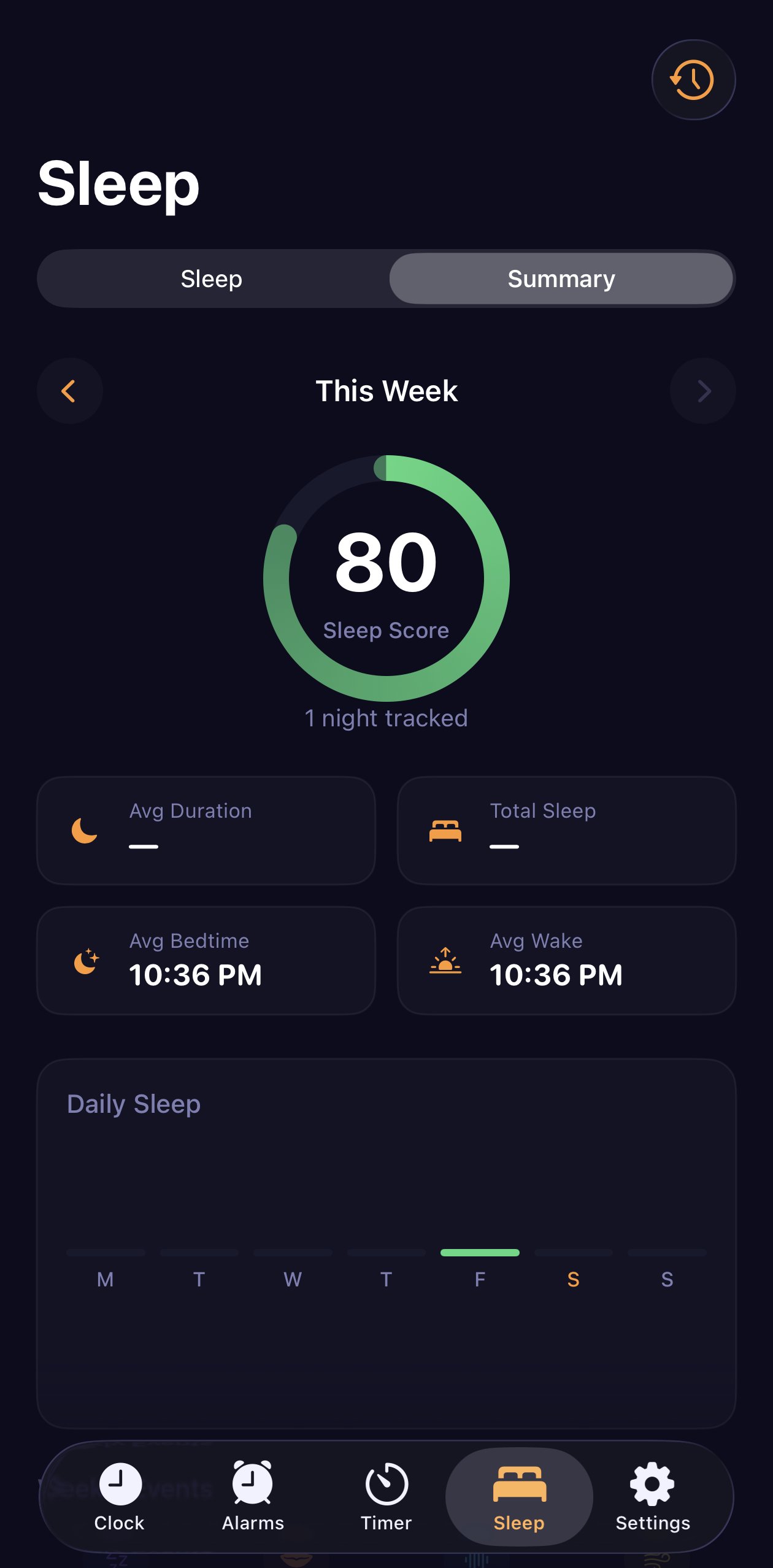
- Note two things each day. How long you slept, from a tracker or a rough estimate, and how alert you felt mid-morning and mid-afternoon without extra caffeine.
- Adjust in small steps. If you lie awake for a long time, or wake well before the alarm feeling fine, move bedtime 15 minutes later. If you still need the alarm to drag you up, move it 15 minutes earlier.
- Read the second week. The amount you sleep once things settle, on days when you feel alert, is a reasonable estimate of your need.
Treat the result as a working figure. Sleep need drifts with age and circumstances, so it is worth repeating the test when your life changes. Once you have a number, work backward from your wake-up time to set a bedtime; for help with the arithmetic, see how to choose the best time to wake up.
Do naps count toward your total?
A nap adds to the sleep you get across the day, and a short one can restore alertness after a poor night. It is a supplement, though, not a substitute. The recommendations above describe night-time sleep on a regular basis, and long or late naps can make it harder to fall asleep that evening.
If you need a nap every day just to function, read that as a sign that your nights are too short or too broken. For timing and length, see the guide to power naps.
Where to start tonight
Decide on a wake-up time you can keep all week, count back the hours for your age group plus a short margin, and make that tonight’s bedtime. Hold it for two weeks before you judge the result.
If the experiment shows you need more sleep than your schedule allows, treat that as information, not failure. A modest, consistent move toward your number tends to be easier to keep, and more useful, than an occasional very long night.
Frequently asked questions
Is 6 hours of sleep enough?
For most adults, no. The consensus recommendation is seven or more hours a night on a regular basis. In one lab study, two weeks of six hours in bed produced attention deficits comparable to up to two nights without any sleep, while participants largely did not feel that impaired. Feeling fine on six hours is not reliable evidence that you are.
Do older adults need less sleep?
Only slightly. The National Sleep Foundation recommends seven to eight hours for adults aged 65 and over, compared with seven to nine hours for younger adults. Sleep also tends to become lighter and more broken with age, so the same amount can take longer to get. Sleeping less easily is not the same as needing less.
Does time in bed count as sleep?
Not all of it. Recommendations refer to time asleep, and nobody sleeps for every minute they spend in bed. Falling asleep takes a while and brief awakenings are normal, so plan to be in bed somewhat longer than your sleep target. If your tracker regularly shows far less sleep than time in bed, look at what is keeping you awake.
How do I know if I am getting enough sleep?
Judge by how you function, not only by the clock. Signs that you are getting enough include waking close to your alarm time without a struggle, staying alert through the afternoon without extra caffeine, and not needing to sleep much longer on days off. If those are true most weeks, your current amount is probably right for you.
Sources
- Hirshkowitz M, et al. National Sleep Foundation's sleep time duration recommendations: methodology and results summary. Sleep Health, 2015. doi.org/10.1016/j.sleh.2014.12.010
- Watson NF, et al. Recommended amount of sleep for a healthy adult: a joint consensus statement of the American Academy of Sleep Medicine and Sleep Research Society. Sleep, 2015. doi.org/10.5665/sleep.4716
- Van Dongen HPA, Maislin G, Mullington JM, Dinges DF. The cumulative cost of additional wakefulness. Sleep, 2003. doi.org/10.1093/sleep/26.2.117
- Windred DP, et al. Sleep regularity is a stronger predictor of mortality risk than sleep duration: a prospective cohort study. Sleep, 2024. doi.org/10.1093/sleep/zsad253
This article is for general information only and is not medical advice. WakeUp 2day is not a medical device and does not diagnose, treat or prevent any condition. If you are worried about your sleep or your health, talk to a doctor.