Waking up
The Best Alarm Sound to Wake Up To, According to Research
The best alarm sound is one that reliably wakes you without leaving you jolted. One small survey study suggests melodic alarms are linked with less morning grogginess than harsh, unmelodic ones, but the evidence is thin. In practice, pick a tune-like sound, make it loud enough, let it rise gradually and change it now and then.
Key takeaways
- One small survey linked melodic alarms with less reported grogginess than harsh ones.
- Loudness decides whether you wake; the character of the sound shapes how waking feels.
- A sound you hear every day gets easier to ignore, so change it from time to time.
- Heavy sleepers need more intensity and a backup; light sleepers can go gentle.
- Pairing sound with light gives you a second wake-up signal.
What does research say about alarm sounds?
Less than you might expect. One study that looked at the question directly was a survey of 50 people, who reported the sound they woke up to and how groggy they felt afterward. Alarms that were rated as melodic were associated with less reported sleep inertia than harsh, unmelodic ones.1
That is an interesting result with real limits. The group was small, the answers were self-reported, and the link is a correlation. It cannot tell us whether the melody reduced the grogginess or whether people who wake easily simply prefer tuneful alarms. Treat it as a reason to try a melodic sound, not as proof that one will work for you.
The idea is at least plausible. A review of sleep inertia research lists sound, alongside light and caffeine, as a candidate countermeasure to the fog that follows waking.2 If you want the background, see why you feel groggy after waking up.
Loudness and character do different jobs
Two properties of an alarm matter, and they are easy to confuse. Loudness decides whether you wake at all. Character, meaning whether the sound is melodic or harsh, smooth or abrupt, shapes how that waking feels.
A harsh sound is not automatically a louder one. A buzzer feels urgent because it is abrupt and dissonant, while a melody at the same volume can wake you just as well and feel less like an emergency. The reverse also holds: soft birdsong is pleasant, but useless if it never reaches you.
So choose in that order. First make sure the alarm wakes you every time, then pick the most pleasant sound that still clears that bar. For most people that means something tuneful at a firm volume, not something aggressive.
Does an alarm that gets gradually louder work better?
A rising alarm starts quietly and gains volume over a set period. The logic is simple: if you are already in light sleep, a quiet sound is enough and you wake without a jolt. If you are sleeping more deeply, the volume keeps climbing until it reaches you. Either way you get roughly the least force needed on that particular morning.
This is sensible reasoning more than a tested result, so judge it by your own mornings. Two cautions apply. A long, quiet start can let you doze through the first part and get up later than planned, so time the ramp to finish when you need to be awake. And the final volume still has to be loud enough for your deepest sleep.
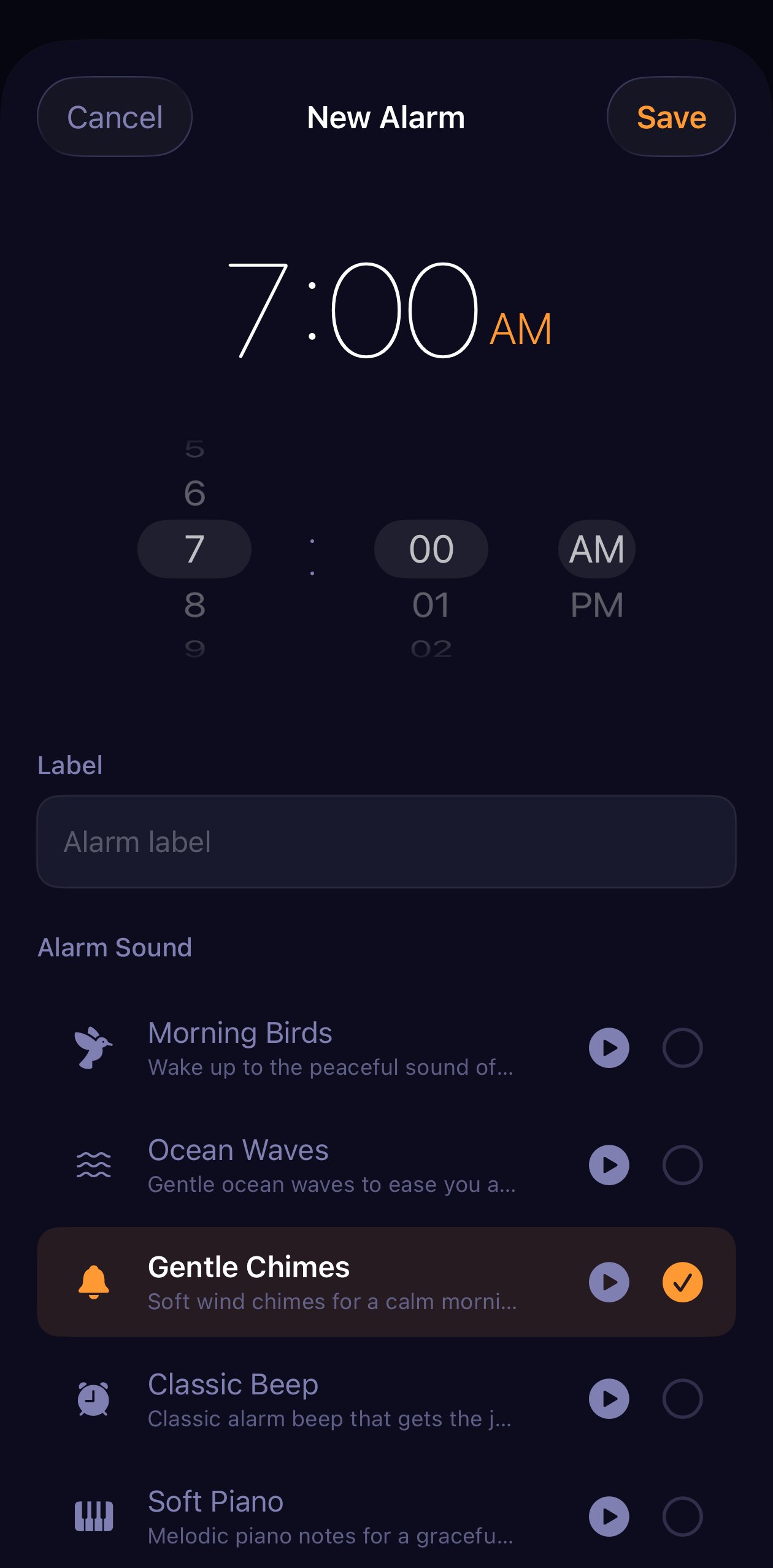
Why your alarm stops working after a few weeks
Brains are good at filtering out sounds that are familiar and predictable. It is why people who live beside a railway stop noticing the trains. An alarm tone you have heard every morning for months can go the same way: it still plays, but it no longer grabs your attention, and you may silence it without really waking.
The fix is variety, not harshness. Change your alarm sound every few weeks, or keep a small set and rotate through it. It also helps to avoid using the same tone for anything else on your phone, and to think twice before choosing a song you love, since many people find that a daily alarm sours it.
If you sleep through alarms often, habituation is only one possible cause, and short sleep is frequently the bigger one. There is a fuller plan in these alarm tips for heavy sleepers.
Which alarm sound suits the way you sleep?
Light sleepers wake to almost anything, so they can put comfort first. Heavy sleepers need to put reliability first and soften things only as far as the alarm still works. Most people sit somewhere between, and the table below is a starting point, not a ranking.
| Sound type | Best for | Watch out for |
|---|---|---|
| Nature sounds (birds, waves, rain) | Light sleepers who want a calm start | Easy to sleep through or mistake for background noise |
| Melodic tunes (piano, chimes) | Most people; a good first thing to try | Becomes familiar quickly, so rotate it |
| Classic beeps and buzzers | Anyone who needs a clear, unmistakable signal | Abrupt, and some people find it stressful |
| Voices and knocking | Sleepers who tune out musical tones | Startling, and awkward in a shared room |
| Sirens and very loud alarms | Heavy sleepers, or as a backup | Jolting and hard on a partner; needing one daily is a reason to look at your sleep |
| Vibration on the wrist | Waking without disturbing anyone else | Easier to miss, so keep a sound as backup |
Pair the sound with light
Sound is not the only signal that reaches a sleeping brain. Light is your body clock’s main cue that morning has come, and a room that brightens as the alarm rings gives you a second, independent nudge. With that support you may be able to use a gentler sound than you would need in a dark room.
The simplest version is leaving the curtains partly open when sunrise roughly matches your wake time. For darker months, a lamp on a timer or smart bulbs tied to the alarm do the same job; here is how to turn smart lights into a sunrise alarm. If the real constraint is a sleeping partner, sound may not be the right tool at all, and there are quieter ways to wake up without waking your partner.
How to test a new alarm sound
A sound that seems fine in the afternoon can fail at dawn, and the reverse. Test it before you depend on it.
- Listen to it during the day, at the volume you plan to use and from where your head will be.
- Try it first on a morning when being late would not matter.
- Keep a louder backup alarm set slightly later until you trust the new one.
- Give it several mornings. One morning tells you more about that night’s sleep than about the sound.
- Judge how you feel a little while after getting up, not in the first seconds.
It is also worth confirming that the alarm will sound at all, because the wrong phone settings can keep some alarm apps silent. If that has caught you out before, read why an iPhone alarm sometimes does not ring.
Where to start tonight
If your current alarm is a harsh buzzer, swap it for something melodic at a volume you are sure will wake you, with a gradual rise if your alarm offers one. Keep a louder backup for the first week. When you notice you have stopped hearing the sound, change it.
Remember that the sound is the last link in the chain. No tone makes up for too little sleep, and if you regularly cannot wake to any alarm despite enough hours in bed, that is worth raising with a doctor.
Frequently asked questions
Is it better to wake up to music or a beeping alarm?
One survey of 50 people found that alarms rated as melodic were associated with less reported grogginess than harsh, unmelodic ones. The data were self-reported and correlational, so this is a hint, not proof. If a tune reliably wakes you, it is a reasonable choice. If you sleep through it, reliability matters more than pleasantness.
What is the best alarm sound for heavy sleepers?
Heavy sleepers usually do better with a sound that is loud, sharp and unfamiliar, because a tone you have heard for months is easier to sleep through. Change it regularly, add a second signal such as light or wrist vibration, and place the alarm out of reach. Regularly sleeping through alarms despite enough sleep is worth mentioning to a doctor.
Why do I sleep through my alarm after a while?
Your brain is good at tuning out sounds that are familiar and predictable, and an alarm you have heard every morning for months fits that description. Switching to a different sound from time to time, or rotating between a few, can keep it noticeable. Short sleep makes the problem worse, so look at your bedtime too.
Should my alarm start quietly and get louder?
A gradual ramp gives you the chance to wake at a low volume while still reaching full volume if you do not. Many people find it less jarring, though that is experience more than proven science. Make sure the final volume is loud enough for you, and test it first on a morning when being late would not matter.
Sources
- McFarlane SJ, Garcia JE, Verhagen DS, Dyer AG. Alarm tones, music and their elements: analysis of reported waking sounds to counteract sleep inertia. PLOS ONE, 2020. doi.org/10.1371/journal.pone.0215788
- Hilditch CJ, McHill AW. Sleep inertia: current insights. Nature and Science of Sleep, 2019. doi.org/10.2147/NSS.S188911
This article is for general information only and is not medical advice. WakeUp 2day is not a medical device and does not diagnose, treat or prevent any condition. If you are worried about your sleep or your health, talk to a doctor.